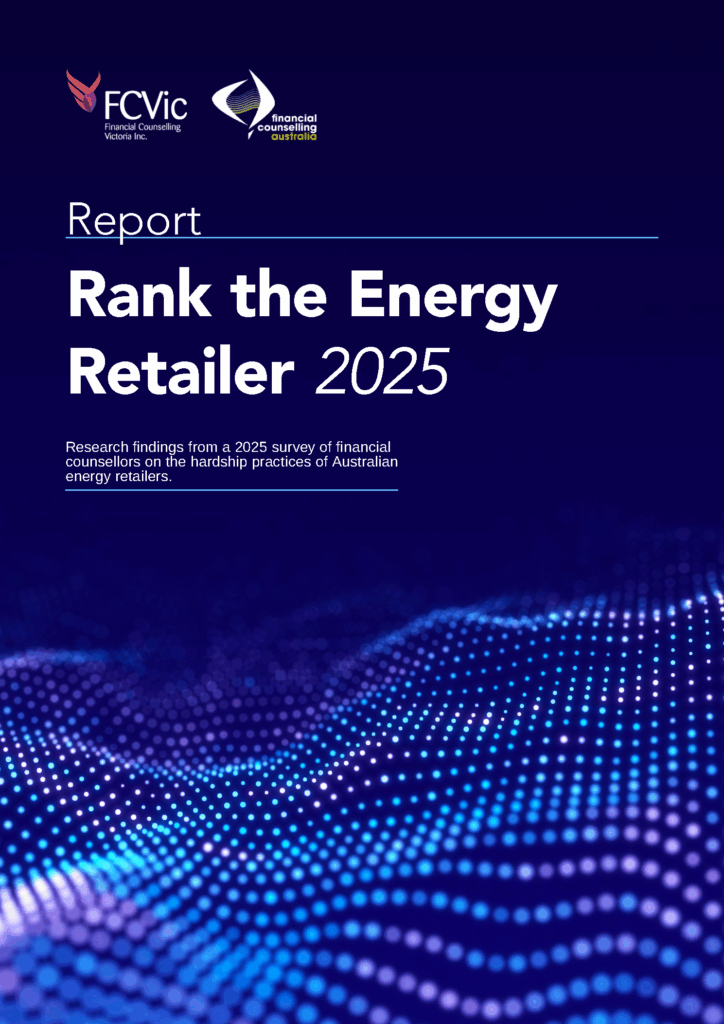
Rank the Energy Retailer 2025
The Rank the Energy Retailer 2025 Report presents the findings from a national survey of financial counsellors in March-April 2025, about their energy casework experiences over the past 12 months. The Rank the Energy Retailer 2025 project seeks to assess the hardship practices of energy retailers in order to remove barriers to affordable energy, and the report makes a number of key recommendations.
Read the full report
Executive Summary
Financial counsellors are at the frontline of Australia’s energy hardship crisis. Every day, they support people facing mounting energy debts, disconnection threats, and complex financial and personal challenges — including job loss, illness, family violence and housing stress. Through this work, financial counsellors develop a detailed understanding of how energy retailers respond to customers in difficulty, and where systemic failures are causing harm.
Despite the existence of formal hardship frameworks, many people continue to miss out on support. Financial counsellors report that clients are often unaware of their entitlements, confused by inconsistent processes, or pushed into unaffordable repayment plans This reflects an ongoing “assistance gap”—one that disproportionately affects people already dealing with significant vulnerability.
In 2025, Financial Counselling Victoria (FCVic), in partnership with Financial Counselling Australia (FCA), the Consumer Policy Research Centre (CPRC) and Energy Consumers Australia (ECA), led a national study surveying more than 400 financial counsellors. The Rank the Energy Retailer research provides clear evidence of inconsistent practices across the energy sector. While some retailers were recognised for compassionate and flexible responses, many others were criticised for rigid policies, poor communication, and inadequate training of hardship teams.
Only 12% of financial counsellors rated energy retailers as “excellent” in their hardship responses—well behind water and banking sectors. Key failings included a lack of proactive support, burdensome eligibility checks, and s. Importantly, these experiences are not isolated—they are seen across all states and territories and represent systemic issues within the energy market.
Energy retailers have a significant role to play in improving outcomes for people experiencing payment difficulty. They can engage earlier, identify customers at risk using available data, and provide support that is empathetic, accessible, and based on what people can realistically afford. Retailers should train their staff in trauma-informed and culturally safe practices, proactively apply concessions and grants, offer flexible payment plans, and provide tailored energy efficiency advice. Disconnections should only occur as a genuine last resort, and systems must be designed to support all customers—particularly those without advocates—through clear communication, easy access to assistance, and continuity of care.
While retailers can and should do more, structural reform is essential to ensure fair and consistent outcomes across the energy market. Voluntary measures and good intentions are not enough when access to support varies widely between providers, and many people in hardship continue to fall through the cracks. Structural reform means establishing nationally consistent, enforceable obligations that guarantee all consumers the right to timely, affordable, and effective support—regardless of who their retailer is or where they live. This includes mandatory minimum standards of assistance, clear rules to prevent disconnection prior to genuine engagement, automatic access to best offers and concessions, and stronger enforcement mechanisms to hold retailers accountable.
We have the evidence. The time to act is now.
Zyl Hovenga-Wauchope
Chief Executive Officer
Financial Counselling Victoria
Dr Domenique Meyrick
Co-Chief Executive Officer
Financial Counselling Australia
Summary of financial counsellor experience ratings
Access to the hardship team and communications received
- Third-Party Authorisation acceptance was rated highest (74%) followed by ease of contacting hardship teams (57%) as the most positive aspects of retailer engagement.
- The most negative aspects were poor communication quality (24%) and lack of proactive accommodation of diverse needs (23%).
Hardship processes and team attitude
- Energy retailer staff attitude (62%) and trust in hardship teams (58%) were rated most positively.
- Key weaknesses were early identification of hardship (33%) and adequate staff training (41%).
Customer outcomes and consistency
- Financial counsellors rated resolution of issues in-house and consistency in arrangements as the most positive outcomes (both 60%).
- The weakest areas were going beyond the bare minimum to support customers (44%) and resolving issues without escalation (38%).
Proactive assistance and support provided
- Financial counsellors perceive the most common support from retailers is affordable payment options, concessions / rebates / grants, and energy efficiency advice.
- Least offered support is in relation to new appliances and energy crisis payments.
- Victim-survivors of family and domestic violence were perceived as the cohort receiving the highest support from energy retailer hardship teams (40%), followed by people with disability, the elderly, and people affected by natural disasters (all 32%).
- Least supported were perceived to be people with unrecoverable debt (14%), scam victims, and small businesses (18%).
Overall energy retailer ranking

Key recommendations
Strengthen protections through regulation, enforcement and implementation
Make support early, accessible and equitable
Provide realistic payment arrangements before debt accrues
Embed a person-centred, future-focused approach
Improve data, monitoring and continuous learning
Leverage relationship with financial counsellors
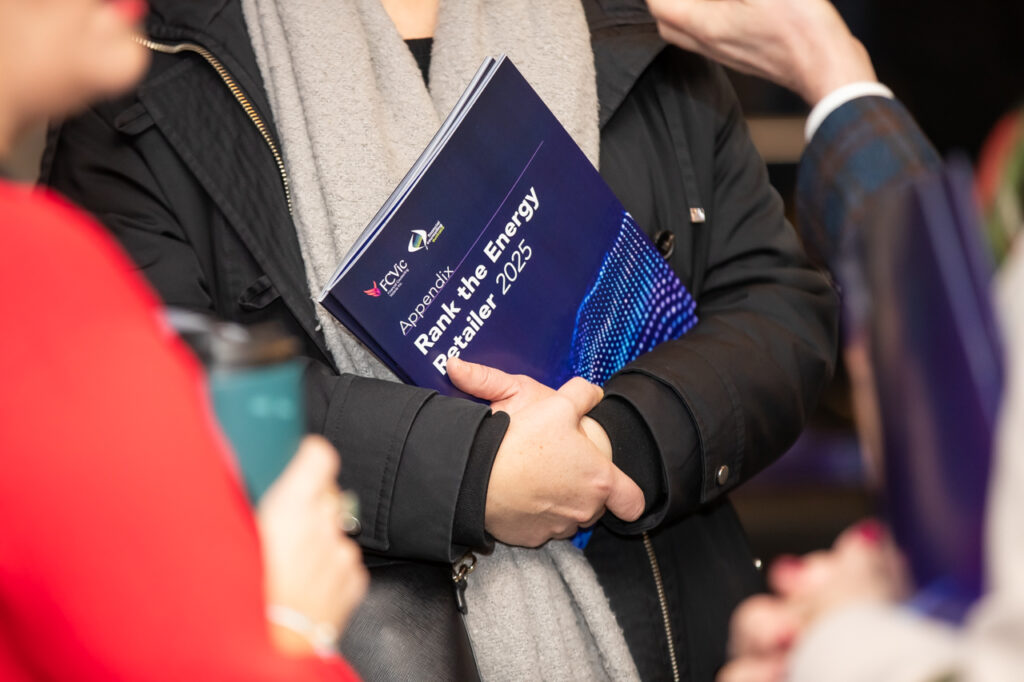
Appendix
About this project
Rank the Energy Retailer 2025 is a collaborative project coordinated by Financial Counselling Victoria (FCVic) and funded through a collaboration grant from Energy Consumers Australia. Partners on the project include Financial Counselling Australia (FCA), Energy Consumers Australia (ECA) and the Consumer Policy Research Centre (CPRC), as well as state peak associations for financial counsellors across Australia.
This project was funded by Energy Consumers Australia as part of its Grants Program to support consumer advocacy and research projects that benefit of household and small business consumers.
The views expressed do not necessarily reflect the views of Energy Consumers Australia.