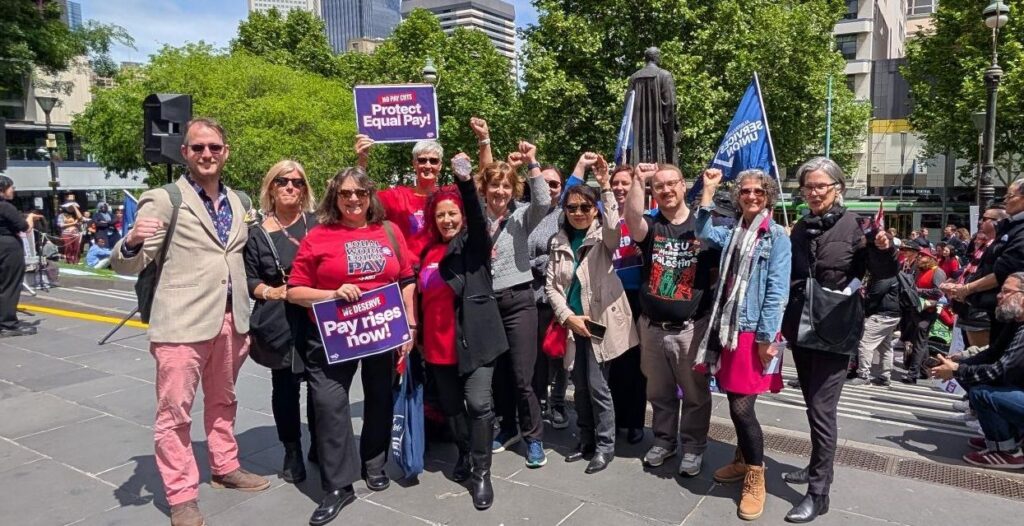

On Thursday, 23 October, FCVic CEO Zyl Hovenga-Wauchope joined community sector colleagues at the Australian Services Union (Vic/Tas Branch) Day of Action outside the State Library of Victoria. The rally brought together workers and advocates standing in solidarity against the Fair Work Commission’s provisional decision on the SCHADS Award.
Zyl spoke powerfully in defence of fair pay for skilled community workers, including financial counsellors, whose voices FCVic continues to amplify in this critical moment. The Commission’s decision, if upheld, would undermine fairness, gender equity, and the sustainability of a sector that exists to protect people from financial harm.
“The Commission’s decision on pay must be rejected — not watered down, not reinterpreted — rejected outright,” Zyl said. “It’s wrong in principle and wrong in practice.”
It was heartening to see so many FCVic members and community sector colleagues attending in person. Your presence and support are a testament to the strength and unity of our sector.
You can watch Zyl’s full speech on LinkedIn — click here — or read the written version below if you prefer text.
Thank you, friends and colleagues, for standing together today, and thank you to the Australian Services Union for organising this rally.
I begin by acknowledging the Traditional Custodians of this land. I pay my respects to Elders past, present and emerging.
I speak today as the CEO of Financial Counselling Victoria, the peak body for financial counsellors right across this state.
Financial counsellors are the people on the frontline of financial hardship in Australia. They sit with people who are facing eviction, repossession, family violence, debt collectors, and the fear of not knowing how to make it through the week.
They work every day to help people keep their homes, provide for their families, and uphold their dignity.
What’s Happening
The Fair Work Commission has released a provisional decision that, on paper, claims to simplify the SCHADS Award and embed the Equal Remuneration Order to address gender-based undervaluation of the caring workforce.
But let’s be honest — what it really does is cut pay for skilled community workers, including financial counsellors.
This decision would merge different award levels into one narrow structure. It would erase recognition of specialist skills, qualifications, and ongoing professional development and accreditation requirements that are central to financial counselling work.
The community sector is not homogenous. The work everyone in the community sector does is specialised, unique, and irreplaceable.
This decision is not simplification — it’s devaluation.
It’s not just numbers on a spreadsheet. It’s food off the table. It’s rent unpaid. It’s financial counsellors — the very people fighting hardship — being pushed into hardship themselves.
What I’ve Seen This Year
This year, I’ve been travelling to financial counselling services across Victoria — from small rural communities to big metropolitan centres.
Everywhere I went, financial counsellors spoke about the same thing: deep worry; fear.
People love this work. They care deeply for their clients. But they are scared.
Scared about whether they could keep doing it if their pay drops by 20 per cent or more.
Scared about whether they could afford to stay in the job that defines their purpose.
At our conference just two weeks ago, I spoke with dozens of financial counsellors — people who’ve been doing this work for years.
They told me they don’t know how they’ll pay their mortgages or keep food on the table if this decision goes through.
This provisional decision is wrong.
Our joint financial counselling sector submission to the Commission gathered hundreds of voices from financial counsellors across Australia. Almost a third of Australia’s entire financial counselling workforce spoke out.
- “If my pay goes down, I will have to leave.”
- “Our work is more complex every year. Cutting pay would break the sector.”
- “Cutting our pay isn’t just a number, it risks tearing apart the support system that helps people keep their homes, their dignity, and hope for a better future.”
- “We are financial counsellors who work with clients presenting with critical issues and needs that cannot be addressed by an accountant, or a financial planner, or a social worker, or a psychologist, or a doctor, or a nurse.”
- “Financial counsellors are highly competent professionals who use counselling skills alongside financial and legal knowledge. Our role can not be classed as simply a caring role, we have specialised expertise which we apply to help vulnerable clients, many with highly complex cases.”
- “Fair and sustainable remuneration is not just about valuing our work—it is about safeguarding a service that prevents homelessness, protects mental health, and supports the financial wellbeing of the community.”
What This Decision Means
Let’s be clear — this is not a small technical change.
This decision means real pay cuts for real people — people already working in an underpaid sector.
For experienced financial counsellors, that could mean losing thousands of dollars a year.
When that happens, we lose more than money — we lose people.
We lose experience, mentorship, and the quiet wisdom that holds services together.
When those people leave, the system frays.
And it’s the clients — people already in crisis — who pay the price.
Longer waitlists.
Fewer services in regional areas.
Less time to give people the care and guidance they need.
It’s cruel, it’s counterproductive, and it completely repudiates the intent of what this review was supposed to achieve — embedding the Equal Remuneration Order into the award, not undoing it.
What Financial Counsellors Actually Do
Let’s remember what this work is.
Financial counselling isn’t entry-level.
It’s skilled, technical, and deeply human work.
A financial counsellor might spend one hour explaining a credit report, the next advocating with a bank, the next helping a client file a hardship application while managing trauma from family violence or gambling harm.
They navigate legal frameworks, financial systems, and emotional crises — all in the same day.
They are qualified professionals with expertise that no one else can simply step in and replace.
They are the safety net behind the safety net — the people who make sure that when someone’s life falls apart financially, they still have somewhere to turn.
And most of them — over seventy per cent — are women.
So when their pay is cut, it’s not just unfair — it entrenches gender inequality.
The Consequences of This Decision
If this decision stands, here’s what will happen:
- Financial counsellors will leave.
- Waitlists will grow.
- Family violence survivors will wait longer for help.
- Regional communities will lose local support.
And the cost-of-living crisis — the one that’s already pushing so many Australians to the brink — will hit even harder, because the people who help others manage that crisis will themselves be drowning in it.
Why It’s Unacceptable
The Commission’s decision on pay must be rejected — not watered down, not reinterpreted — rejected outright.
It undermines fairness, it undermines gender equity, and it undermines the sustainability of a sector that exists to protect people from financial harm.
It’s wrong in principle and wrong in practice.
We are asking for fairness.
We need pay and conditions that reflect the skill, professionalism and responsibility of this work.
The Commission should:
- Suspend this provisional decision immediately and publicly; to alleviate the alarm they have caused to the whole sector.
- Maintain, if not increase, existing SCHADS pay levels for financial counsellors.
- Recognise qualifications, professional development, and experience within the Award.
- Guarantee equal pay for equal work — no two-tier systems, no downgrades, no trickery.
Because the people who stand between families and foreclosure, between debt and despair, deserve respect — not pay cuts.
Closing & Call to Action
To every financial counsellor, ASU member and community worker here today:
I know it feels like we keep having to fight for fairness that should already exist. Stand firm. Speak up. Fight back.
We’ve seen what happens when we stand together — and I believe we can turn this one around, too.
So, to the Fair Work Commission:
Do the right thing. Suspend this decision. Recognise the value of this profession.
To governments:
Don’t stand by. Fund fairness — not failure.
And to every worker here:
Stay united, stay loud, stay proud.
Because when we fight together, we win together.
Thank you.